

 Donor Nexus Team
August 27, 2026

The short answer
No home study is required to receive donor embryos through a medical tissue donation model like the Donor Nexus Donor Embryo Program. Home studies belong to adoption-model programs, and the ASRM Ethics Committee says home studies and judicial intervention are "not appropriate or justified" in assisted conception through medical means.1,2
Instead, recipients sign a donation agreement and complete a physician consult and medical pretesting, and most families move from selecting a profile to transfer in 2 to 3 months.
A home study is an assessment of a prospective parent's background, relationships, health, finances, and home, and it comes from the legal process of adopting a child. Some programs that call the use of donated embryos embryo adoption apply that same assessment to recipients, while the Donor Embryo Program at Donor Nexus follows a medical tissue donation model with no home study. This guide explains what each path asks of you, so you can see which requirements apply before you choose a program.
The frozen embryo transfer at the center of both models is the same medical procedure, so the differences you notice come mostly from the legal framework around it: how long you wait, what you pay before transfer, and who reviews your household. For a broader look at the two frameworks, including openness and cost, see how embryo adoption and embryo donation differ.3
Why doesn't embryo donation require a home study?
Embryo donation doesn't require a home study because the donation model treats the transfer as a medical procedure using donated reproductive tissue, not as the legal adoption of a child.2 The Ethics Committee of the American Society for Reproductive Medicine (ASRM) addressed this directly in its 2023 opinion, stating that the term adoption is inaccurate for embryos and should be avoided.1
The committee explained that home studies, other assessments of parental fitness, and judicial intervention are standard elements of adoption, and that they are not appropriate or justified when a family is built through assisted conception by medical means.1 It also noted that adoption procedures would place unwarranted burdens on both donors and recipients, and that the adoption label reinforces a view of the embryo as a fully entitled legal being. In the committee's view, embryos have the potential to become persons but should not be given the same legal status as a person. Protections written for children already born, like the cooling-off period that adoption laws in almost every state require after a birth, were designed for a different situation.1
None of this means receiving donor embryos comes without requirements. Your screening is medical, overseen by an IVF physician, and your commitments are set out in a donation agreement you sign before your embryos are secured.4
What does a home study typically involve?
A home study typically involves interviews, at least one home visit, criminal and child abuse record checks, references, and documentation of your health and finances, and it takes 3 to 6 months on average to complete.5 The Child Welfare Information Gateway, a service of the U.S. Children's Bureau, describes these common components:5
- Interviews. A social worker asks about your experiences with children, your important relationships, your approach to parenting, and how you handle stress.
- Home visits. A visit confirms that your home offers a safe environment for a child and meets state licensing standards.
- Health statements. Most agencies ask for a recent physical exam and a doctor's statement about your health.
- Income statements. You verify your income with documents such as pay stubs, W-2 forms, or tax returns.
- Background checks. All states require criminal and child abuse record checks for adoptive parent applicants.
- References. The agency may contact several people who know you.
- Autobiographical statement. Many agencies ask you to write the story of your life.

Requirements vary from agency to agency and state to state, and so does the price.5 The same federal resource notes that a private agency or certified home study specialist might charge $1,000 to $3,000, and Donor Nexus lists $2,000 to $3,500 as the home study cost for embryo adoption programs.5,3 For how that fee fits into a full budget, see the breakdown of embryo adoption cost and donor embryo cost.
What does Donor Nexus require instead of a home study?
Instead of a home study, Donor Nexus asks you to secure your embryos with signed paperwork, complete a consult and pretesting with an IVF physician, and follow a medication protocol before a frozen embryo transfer at HRC Fertility.4 The Donor Embryo Program has no wait list, and the steps run in this order:2,4
- Register and browse. Register for free to browse donor embryo profiles in the online database. Each profile shows whether the donating family chose open ID or nonidentified donation.
- Secure your embryos. Send your name and date of birth, your partner's name and date of birth if applicable, and your mailing address. Donor Nexus emails preliminary paperwork, an invoice, and an agreement, and you have one week to complete the paperwork and submit funds. Your embryos are secured once the signed contract and funds are received.4
- Consult with a physician. You are put in contact with the partner clinic to schedule a consultation.4
- Complete pretesting. The IVF physician orders a uterine cavity evaluation, either a sonohysterogram or a hysteroscopy with a mock embryo transfer, and a state-mandated infectious disease panel for you and your partner.4
- Confirm your cycle dates. Once pretesting is complete, you set cycle dates with your nurse coordinator.4
- Take medications. You are on medications for about 35 days before the transfer, with 2 to 3 monitoring ultrasounds along the way.4
- Travel for the transfer. The frozen embryo transfer takes place at HRC Fertility in Newport Beach or Encino. Most physicians require 2 days of bed rest afterward, so plan for about 4 days in Southern California if you live elsewhere.4,2
- Take a pregnancy test. Your first blood bhCG level is drawn 10 to 12 days after the transfer.4
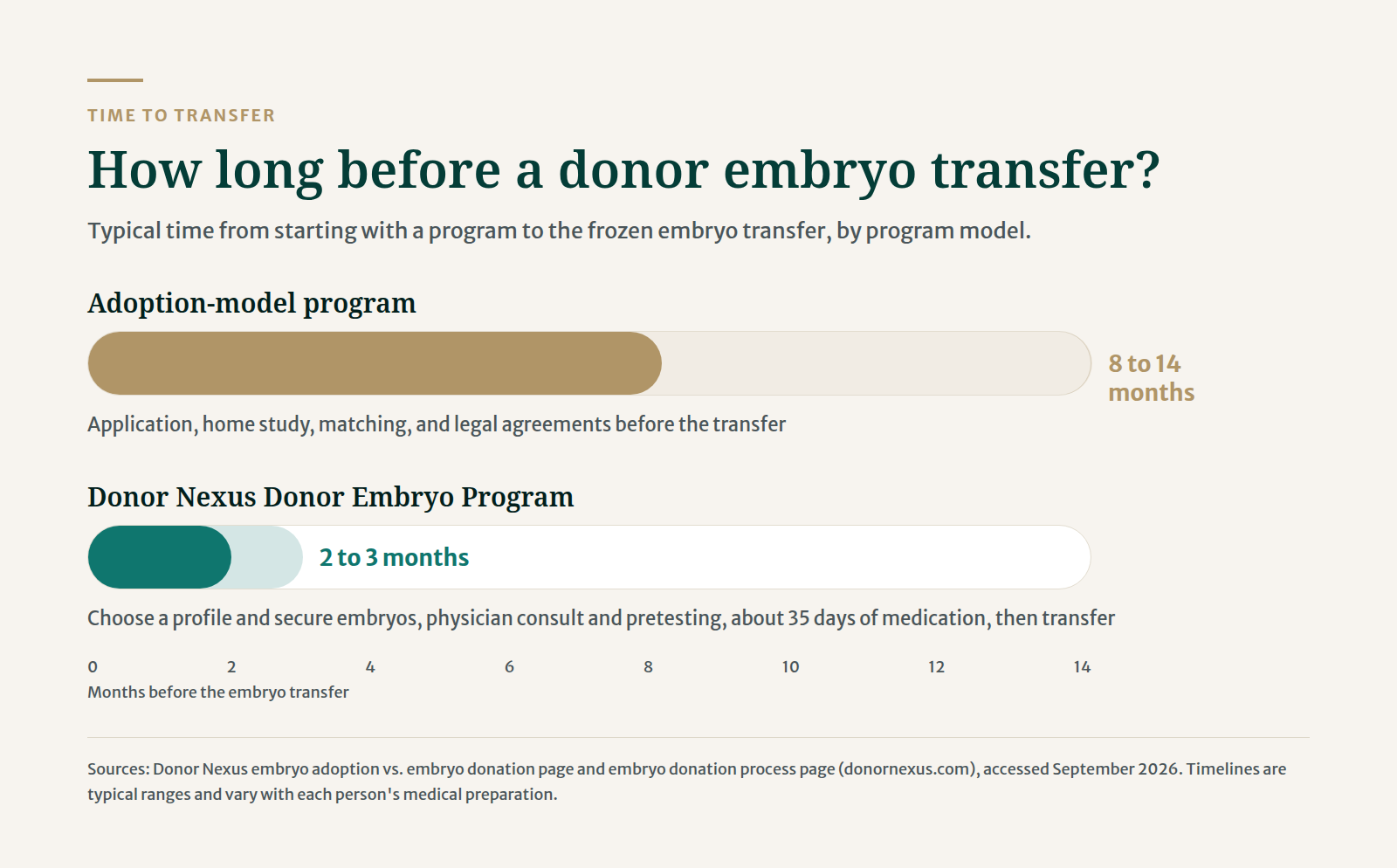
Typical time before transfer in each model. Source: Donor Nexus embryo adoption and embryo donation process pages, September 2026.3,4
Who can use the Donor Embryo Program?
Single parents, same-sex couples, unmarried partners, and married couples can all use the Donor Embryo Program, which is non-religious and non-discriminatory.2 Donating families can express specific wishes or stipulations for the recipients of their embryos, so ask the team about any stipulations on a profile you are considering.3 You also don't need to live in California: pretesting and monitoring can typically be done at a fertility clinic close to you, while the embryos stay at the partner clinic because they cannot be shipped.2
Are there extra requirements for recipients over 45 or after a recent birth?
Recipients over 45 usually need additional testing, and recipients who recently gave birth need to wait before starting a cycle.4 For patients over 45, most physicians order a stress test, EKG, chest X-ray, mammogram, and pap smear. After a delivery, the waiting period is at least 9 months after a vaginal birth and at least 12 months after a C-section, and if you are breastfeeding, you need to stop and have 2 normal periods before completing pretesting.4
What are the benefits of embryo donation compared with the adoption model?
The main benefits of embryo donation compared with an adoption-model program are no home study, a shorter typical timeline, and a lower fee before transfer, while the frozen embryo transfer itself is the same in both.3 The table shows how the two models differ on the points recipients ask about most.
| Consideration | Adoption-model program | Donor Embryo Program (donation model) |
|---|---|---|
| Home study | Often required, commonly $2,000 to $3,500 | Not required |
| Legal framework | Legal adoption process, often with a home study and legal contracts | Medical tissue donation model with a donation agreement, facilitated by the agency and clinic |
| Typical time before transfer | 8 to 14 months | 2 to 3 months from selecting a profile |
| Matching or program fees | $10,000 to $15,000 for matching; clinic fees billed separately | $9,400 USD per cycle, including 1 to 3 embryos; clinic fees billed separately |
| Openness options | Set by each program; ask how contact between families works | Open ID or nonidentified, set by the donating family and listed on each profile |
| Who chooses | Set by each program's matching process | You choose the profile; donating families can express stipulations for recipients |
Figures and model descriptions from Donor Nexus embryo adoption and Donor Embryo Program pages, September 2026.3,2
Openness is one area where the donation model gives you room to choose. Open ID profiles come from donating families who have agreed to release identifying information to a donor-conceived person at 18 or older on request, and the guide to open ID and nonidentified embryo donation explains how each option works.
Who are the legal parents after embryo donation?
According to ASRM, recipients assume the legal rights and duties over the embryos and any resulting children once they receive the donation, and donating embryos does not give donors legal rights or duties to rear those children.6 Under that guidance, the recipients, not the embryo donors, hold the parental rights and responsibilities, and the recipient who carries the pregnancy does so without being genetically related to the baby.

In the donation model, the paperwork and agreement you sign when you secure your embryos document the donation.4 Parentage law can differ by state and country, so if your family situation raises specific legal questions, a reproductive law attorney can review how the rules apply where you live.
“We had been to 3 other doctors who had told us there was a 2-year waiting list for donated embryos. Finding this program was a godsend.”
J.D., intended parent, Orange County, California · Read more from Donor Nexus families
Frequently asked questions about embryo adoption home studies
What are the benefits of embryo donation vs. embryo adoption?
Embryo donation through a medical tissue donation model skips the home study and typically moves from selecting a profile to transfer in 2 to 3 months, compared with 8 to 14 months in adoption-model programs. At Donor Nexus, the program fee is $9,400 USD per cycle, and you can choose open ID or nonidentified profiles.
Does Donor Nexus screen recipients without a home study?
Screening in the donation model is medical and handled by your IVF physician. Before a frozen embryo transfer, the physician orders pretesting, including a uterine cavity evaluation and a state-mandated infectious disease panel for you and your partner, plus the added tests most physicians request for recipients over 45. You also sign an agreement before embryos are secured.
Do you have to live in California to receive donor embryos?
No. Recipients from other states and countries can use the Donor Embryo Program. Pretesting and monitoring can typically happen at a fertility clinic near you, and the transfer takes place at HRC Fertility in Southern California, so you plan for about 4 days there because the embryos cannot be shipped.
Can you have an open relationship with the donating family without a home study?
Yes, if you choose an open ID profile. Open ID means the donating family agreed to release identifying information to the donor-conceived person at 18 or older on request, and some profiles offer facilitated video calls without sharing identities. A home study is not part of setting up either option.
If the donation model fits your family, you can register for free to browse profiles in the embryo bank and share any questions with your fertility physician before you secure embryos. The Donor Nexus team can talk through requirements, timing, and travel with you at info@donornexus.com or +1 (949) 433-5635, Monday to Friday, 8 a.m. to 4 p.m. Pacific, and the embryo donation process page lays out each step in more detail.
Sources
- Ethics Committee of the American Society for Reproductive Medicine. Defining embryo donation: an Ethics Committee opinion. Fertility and Sterility. 2023;119(6):944-947. doi:10.1016/j.fertnstert.2023.03.007.
- Donor Nexus. Donor Embryo Program. Accessed September 2026. https://donornexus.com/embryo-donation.
- Donor Nexus. Embryo adoption vs. embryo donation. Accessed September 2026. https://donornexus.com/embryo-adoption.
- Donor Nexus. Embryo donation process. Accessed September 2026. https://donornexus.com/embryo-donation-process.
- Child Welfare Information Gateway. The Adoption Home Study Process. U.S. Department of Health and Human Services, Administration for Children and Families, Children's Bureau; 2020. https://www.childwelfare.gov/pubPDFs/f_homstu.pdf.
- Ethics Committee of the American Society for Reproductive Medicine. Interests, obligations, and rights in gamete and embryo donation: an Ethics Committee opinion. Fertility and Sterility. 2019;111(4):664-670. doi:10.1016/j.fertnstert.2019.01.018.
Related reading



Medical disclaimer
This article shares general information about home study requirements and receiving donor embryos and is not medical or legal advice. Your fertility doctor knows your history and treatment plan, so their guidance comes first. National figures and Donor Nexus outcome data describe past results and do not predict the outcome of any individual cycle.
Last updated October 2026. Figures cited here are drawn from the sources listed above.

Donor Nexus Team
The Donor Nexus Team is the group of case managers, donor coordinators, and egg bank staff who run the agency's Fresh Donor Matching, Frozen Egg Bank, and Embryo Donation programs day to day. Since 2012 they ha…

Ready for the next step?
If you are ready to get started or just need more info, contact us today.