

 Lucy Solie-Vilker
October 14, 2026

The short answer
IVF with donor eggs has some of the highest success rates in fertility treatment, with live birth rates of about 45% to 55% per embryo transfer.1 When recipients use the embryos from one set of donor eggs across more than one transfer, studies show cumulative success rates of roughly 67% to 79%.2,5
These figures are averages, not a prediction for any individual treatment plan.
What are donor egg IVF success rates per embryo transfer?
IVF with donor eggs leads to a live birth in about 45% to 55% of embryo transfers, based on SART’s 2023 national data.1
| Donor egg cycle type | Cycles started or thawed | Embryo transfers | Live births per cycle start or thaw (SART) | Estimated live births per transfer (calculated) |
|---|---|---|---|---|
| Fresh donor eggs | 709 | 501 | 38.5% | About 54.5% |
| Frozen donor eggs | 2,564 | 2,164 | 37.9% | About 45% |
| Thawed embryos from donor eggs | 16,751 | 16,701 | 46.6% | About 46.7% |
Donor egg outcomes for all U.S. SART member clinics in 2023. Live births per cycle start or thaw are as SART reports them, and live births per transfer are calculated by dividing reported live births by embryo transfers.1
Understanding these numbers
Per cycle start vs. per transfer: Per cycle start counts every recipient cycle from the day it begins, so it includes cycles that ended early because eggs didn't survive warming or no embryo was ready to transfer. Per transfer only counts cycles that reached an embryo transfer, which is why it runs higher and shows how likely a single transfer is to lead to a live birth.
What is the cumulative IVF success rate from one set of donor eggs?
In published clinic data, roughly 67% to 79% of donor egg recipients have at least one baby once all the embryos from a single donor egg cohort have been transferred. That figure is called a cumulative success rate, because it counts every transfer from the same cohort, fresh and frozen, rather than only the first one. Recipients whose first transfer doesn’t work can still use their remaining embryos for a second or third try, so cumulative rates run higher than per-transfer rates and give a fuller picture of what one donor cycle can lead to. Keep in mind that these programs may have given recipients more eggs than a single six-egg frozen cohort, so your own cumulative chances depend on how many chromosomally normal embryos you end up with, which our guide to how many donor eggs you need walks through. The table below shows results for three treatment groups from two clinic studies.
| Study and treatment group | Study population | Live birth after first transfer | Cumulative outcome |
|---|---|---|---|
| Assisting Nature, Greece 2018–2023; fresh donor eggs 5 |
112 recipient cycles | 59.8% | 69.6% cumulative live birth |
| Assisting Nature, Greece 2018–2023; vitrified donor eggs 5 |
102 recipient cycles | 58.8% | 66.7% cumulative live birth |
| IVI, Spain 2007–2013; vitrified donor eggs2 |
3,467 donation cycles 3,610 egg-warming procedures |
Not reported as a first-transfer live birth rate in the abstract | 78.8% cumulative delivery per donation cycle |
These studies cannot be combined into one universal cumulative success rate, because they involved different countries, time periods, patient populations, donor egg protocols and laboratory methods.2,5
Understanding these numbers
The Assisting Nature figures count the first transfer plus any later transfers from the same cycle, which in this study went up to a third transfer. Not every recipient needed more than one: 44 of 112 fresh-egg recipients and 31 of 102 frozen-egg recipients had a second transfer, and 13 and 2 had a third, an average of about 1.5 and 1.3 transfers per recipient.5 The IVI figure comes from a much larger program, 3,467 donation cycles in Spain between 2007 and 2013, and counts deliveries from the fresh transfer and all later frozen embryo transfers from the same donation cycle.2
Understanding what donor egg IVF success rates measure
A success rate only means something once you know which milestone counts as success and which cycles are in the denominator. Clinics, agencies and egg banks report different stages of treatment, so a program quoting a pregnancy rate can look stronger than one quoting a live birth rate even when outcomes are similar.
Here are the common milestones tracked in donor egg IVF, from egg retrieval to birth:
- Blastocyst development: fertilized eggs that grow into five- or six-day embryos.
- Chromosomally normal (euploid) embryos: blastocysts that test normal on preimplantation genetic testing.
- Positive pregnancy test: a positive hCG blood test after the embryo transfer.
- Clinical pregnancy: a pregnancy confirmed by ultrasound.
- Ongoing pregnancy: a pregnancy that is still progressing normally at 12 weeks.
- Live birth: a baby born alive, the outcome that SART and the CDC use to report success.
The earlier milestones shape how many embryos you will have to work with, which makes a significant difference in your chance of cumulative success, meaning your chance of a baby across all of your transfers.
| Metric | What it counts | How to read it |
|---|---|---|
| Egg survival after warming | Frozen eggs that survive the thaw | A lab measure for egg banks that happens before fertilization |
| Fertilization and blastocyst rates | Eggs that fertilize, and embryos that grow to the blastocyst stage | Reflects egg quality and lab conditions, not pregnancy |
| Positive pregnancy test | A positive hCG blood test after transfer | Includes very early losses, so it runs well above live birth |
| Clinical pregnancy | A pregnancy confirmed on ultrasound | Closer to the outcome, though losses can still occur |
| Ongoing pregnancy or delivery reported | A pregnancy still progressing at a defined follow-up point, or a delivery reported by the clinic | A strong measure when the follow-up point is clearly defined |
| Live birth | A baby born alive | The main outcome SART and the CDC use to report success |
Common donor egg success rate metrics, from earliest to latest stage of treatment.
How does the donor egg blastocyst success rate differ from the euploid rate?
A blastocyst is an embryo that has developed for five or six days, and a chromosomally normal (euploid) embryo is a blastocyst that has also been tested and found to have the expected number of chromosomes. Not every blastocyst passes that test: in Donor Nexus fresh cycles, about 6 in 10 blastocysts come back chromosomally normal.6 The same gap shows up with frozen eggs. About 4 in 5 Frozen Egg Bank patients obtain at least one blastocyst,7 while among the cohorts that went on to chromosomal testing, closer to 3 in 5 produced at least one euploid embryo.6
How many embryos does one set of donor eggs produce?
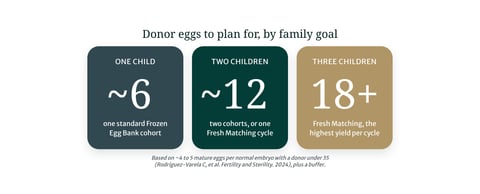
In the Donor Nexus Fresh Matching Program, one donor cycle produces an average of 28.9 eggs retrieved, 22.6 mature eggs and 18.2 fertilized eggs, which leads to about 7.2 chromosomally normal embryos when PGT-A testing is performed.7 Frozen egg bank cohorts generally include six eggs, and some donors may have additional eggs available for an additional cost. Because the two programs start with such different egg counts, the clearer way to compare them is how many eggs it takes to produce one chromosomally normal embryo: about 3 mature eggs with fresh donor eggs and about 4 warmed eggs with frozen donor eggs.6 Those are averages, and small cohorts vary, so for planning it is safer to count on about 5 to 6 frozen eggs for each chromosomally normal embryo you hope to have.
Our guide to how many donor eggs you actually need walks through that math by age and by program.
What are donor egg success rates by age?
Donor egg success rates stay fairly steady for recipients into their late 30s and 40s, because the eggs come from a younger donor. In CDC data from 2021, live birth rates per embryo transfer with donor eggs stayed between about 37% and 44% at every age group shown below, including over 45, while rates with a patient’s own eggs fell from about 43% under age 30 to about 12% past 45.14
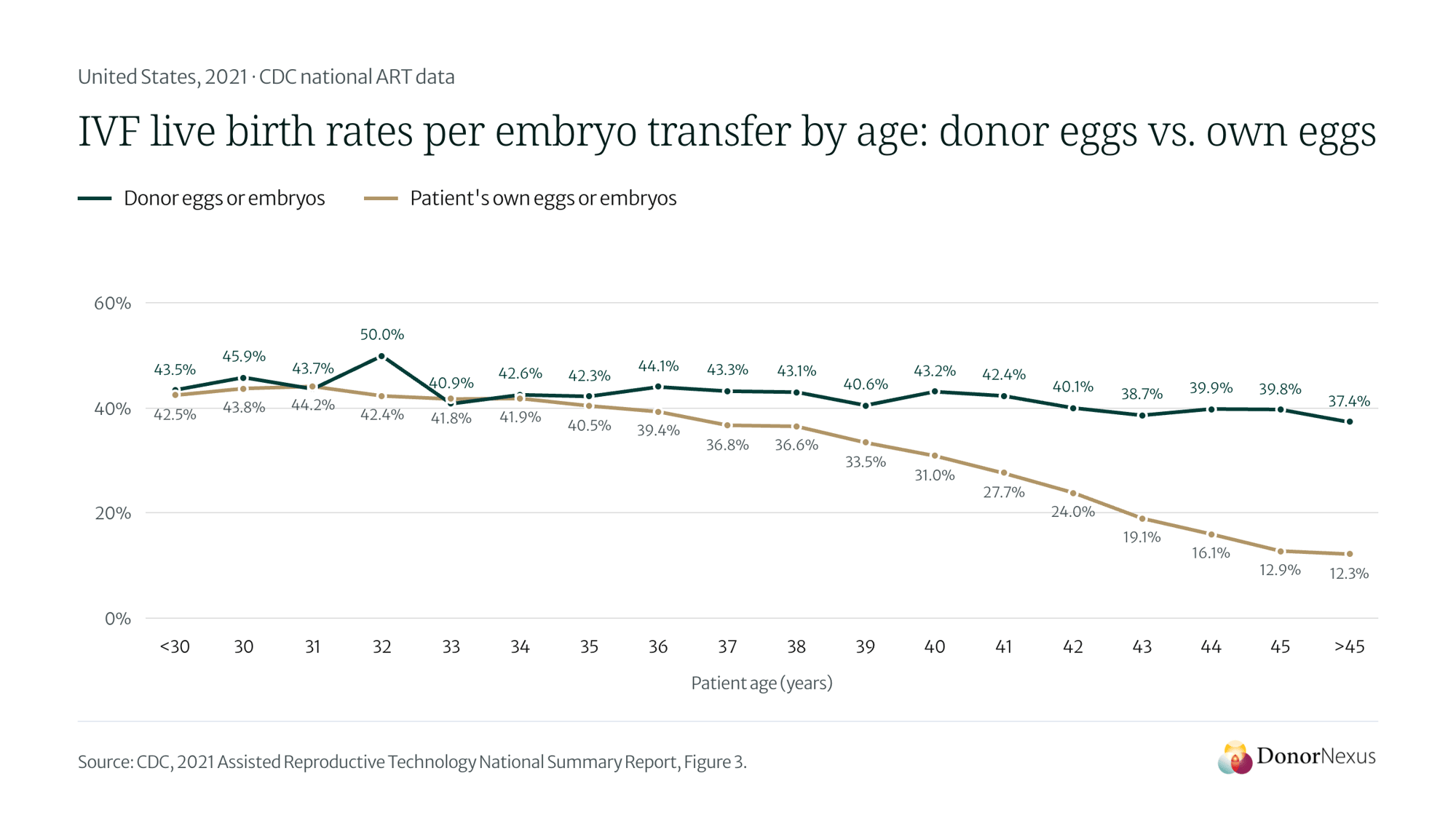
Donor egg IVF success rates broken down by recipient age
The table below shows the same CDC figures by age group, so you can compare donor egg and own-egg outcomes side by side at your age. Each number is the share of embryo transfers that led to a live birth in 2021, which means cycles that ended before a transfer aren’t included.
| Patient age at transfer | Live births per transfer: donor eggs or embryos | Live births per transfer: patient's own eggs or embryos |
|---|---|---|
| Under 30 | 43.5% | 42.5% |
| 35 | 42.3% | 40.5% |
| 38 | 43.1% | 36.6% |
| 40 | 43.2% | 31.0% |
| 42 | 40.1% | 24.0% |
| 43 | 38.7% | 19.1% |
| 45 | 39.8% | 12.9% |
| Over 45 | 37.4% | 12.3% |
Live births per embryo transfer by patient age, U.S. 2021, CDC national data.14
Do donor egg success rates drop after 40?
Donor egg success rates drop only slightly after 40, from about 43% per embryo transfer at age 40 to about 37% over 45 in 2021 CDC data.14 A 2025 U.S. study of chromosomally normal donor egg embryo transfers found live birth rates of about 45% to 49% among recipients ages 38 through 45 and older, with similar results across those age groups.11 That steadiness is one reason many women in their 40s who have been through several IVF cycles with their own eggs start looking at donor eggs.
Does recipient age matter for a donor egg IVF cycle?
Recipient age matters less with donor eggs than with a patient’s own eggs, but your age and overall health still play a role in whether a transfer leads to a live birth. Before a donor egg transfer, clinics routinely evaluate the uterine lining and cavity so that problems such as polyps or fibroids can be treated first, and sperm quality, embryo quality and the clinic’s own practices also affect the outcome.
Donor Nexus success rates and outcomes
At Donor Nexus, we publish our results at each stage of donor egg production, including how many eggs our donors produce, how many survive warming, and how many fertilize, grow into blastocysts and test chromosomally normal. You can find the figures for each of our programs on our success rates page.
our commitment to transparency
You should be able to see where a number comes from before you plan a family around it.Fresh Matching Program outcomes
| Fresh Matching outcome | Average per donor cycle |
|---|---|
| Eggs retrieved | 28.9 |
| Mature (MII) eggs | 22.6 |
| Eggs fertilized through ICSI | 18.2 |
| PGT-A normal embryos, where PGT-A was performed | 7.2 |
Donor Nexus Fresh Matching Program outcomes across 757 donor cycles, 2012 to 2025.7
Frozen Egg Bank outcomes
| Frozen Egg Bank outcome | Result |
|---|---|
| Egg survival after thaw | 90.7% |
| Fertilization rate of surviving eggs (ICSI) | 83.1% |
| Patients who obtained at least one blastocyst | 81.1% |
| Patients who obtained at least two blastocysts | 60.5% |
Donor Nexus Frozen Egg Bank outcomes, 2012 to 2025.7
What is not captured in every dataset
Receiving clinics report some treatment outcomes voluntarily, so detailed egg-to-embryo and transfer follow-up may not be available for every cohort. Clinics tend to report back more reliably when a cycle went poorly. We are working to collect outcome reports on every cohort. These internal figures describe reported program outcomes and do not predict the outcome of an individual cycle.
What affects egg donation IVF success rates?
Because egg donors are young and go through medical, genetic and fertility screening before they are matched, the eggs tend to be one of the more consistent parts of a donor egg cycle, though they still vary from donor to donor. That consistency is a large part of why donor egg success rates hold steady through a recipient’s 30s and 40s, and it means what makes the biggest difference in your chances of a baby, whether from one transfer or several, is how many chromosomally normal embryos you end up with, the skill of the clinic and lab doing the work, and the health of your uterus and body overall.
A SART registry analysis of 40,485 donor egg cycles found that live birth rates after single embryo transfer were linked to recipient age and body mass index (BMI), the embryo’s stage at transfer and the number of eggs retrieved.8
| Factor | What the research shows |
|---|---|
| Donor age and screening | Euploid blastocyst rates did not change significantly with donor age between 18 and 34, so the youngest donor is not automatically the best match9 |
| Recipient age | Live births per donor egg transfer slightly dip with recipient age, about 44% for recipients under 30 to 37% past 45 in 2021 U.S. data14 |
| Recipient BMI | The SART analysis found live birth rates declined steadily as BMI rose above normal,8 while an earlier meta-analysis including 4,758 recipients found no clear effect of obesity on outcomes, including live birth10 |
| Embryo stage at transfer | Blastocyst transfers had a 52.5% live birth rate compared with 39.5% for earlier cleavage-stage embryos8 |
| Number of eggs | Live birth rates rose steadily as more eggs were retrieved, compared with cycles that retrieved fewer than 168 |
Factors linked to donor egg IVF outcomes in published research.
Does PGT-A improve donor egg success rates?
PGT-A may help some patients select which embryo to transfer first, but evidence has not established that routine PGT-A improves the chance of a live birth for every IVF patient or every donor egg cycle.12 In one 2025 study of single frozen donor egg embryo transfers, live birth rates were not significantly different between tested and untested embryos (57.5% vs. 50.0%).13 Decisions about PGT-A should be individualized with a reproductive endocrinologist.
Do sperm quality and the clinic matter?
Sperm quality and the clinic both play a part in donor egg outcomes. A semen analysis is a standard part of the workup before a donor egg cycle, so sperm concerns can be addressed before the eggs are fertilized. The embryology lab and the physician performing the transfer also shape results, which is one reason the CDC advises caution when comparing clinics.4
What can cause donor egg IVF to fail?
When a donor egg transfer does not result in a live birth, the immediate outcome is usually unsuccessful implantation or pregnancy loss. In many cases, the exact biological reason cannot be identified. Even with eggs from a young donor, not every embryo is chromosomally normal. And even a chromosomally normal embryo from donor eggs leads to a live birth only about half the time, according to the 2025 study cited in the age section above,11 so one unsuccessful transfer is common and does not mean the next one will fail.
When a transfer does not work, the cause usually falls into one of a few areas:
- The embryo: chromosomal or developmental problems that testing cannot always detect, especially in embryos that were not tested.
- The uterus: fibroids, polyps, scar tissue, adenomyosis or a thin uterine lining can make implantation harder.
- Sperm: sperm DNA fragmentation and other sperm factors can affect how embryos develop.
- Overall health: a higher BMI, untreated thyroid problems, poorly controlled diabetes and smoking are all linked to lower success.
- The lab and the transfer: embryo culture, freezing and warming, and the transfer itself all depend on the skill of the clinic team.
After a failed transfer, your reproductive endocrinologist can review what happened and recommend testing, such as an evaluation of the uterine cavity, before you try again. If you are working through the emotional side of a failed cycle, our post on what happens after IVF fails shares one mother's experience and the decisions that came next.
If you're exploring donor eggs, our guides to using donor eggs, how our egg donor agency works and our frozen donor egg bank walk through each path, and you can create an account to search the egg donor database whenever you're ready.
Questions to ask your clinic or egg bank
When comparing programs, it helps to know exactly what each number is measuring, whether that is per cohort of eggs, per warming, per embryo transfer or per patient, because the same program can look very different depending on which one it uses. These questions will help you compare programs on the same terms:
About the success rate
- Is this a live birth rate, and is it counted per cycle start, per transfer or cumulatively?
- If it is cumulative, how many transfers does it include, and what is the average number of transfers per recipient?
- Does the outcome measure live birth, delivery or ongoing pregnancy?
- Does the figure count blastocysts or chromosomally normal embryos?
- Does it cover donor egg cycles only, and does it separate fresh eggs, frozen eggs and frozen embryo transfers?
- Which years and how many cycles does it include?
About the clinic and lab
- Does the clinic report to SART and the CDC, and can you see its clinic report?
- How many donor egg cycles does the lab handle each year, and how much experience does it have with frozen donor eggs?
- What share of fertilized eggs reach the blastocyst stage in your lab?
- Do you ever transfer embryos before the blastocyst stage, and if so, when?
About the eggs and donor
- How are donors medically, genetically and psychologically screened?
- For an egg bank, what is the warming survival rate, and how many eggs come in each cohort?
- How many eggs or embryos am I likely to have to work with?
About your own health
- Do you recommend any additional health screening before a donor egg pregnancy at my age?
- Do you have BMI guidelines for donor egg transfer?
Our list of questions to ask before you choose an egg donor agency covers the rest of that conversation, and our roundup of egg donation agencies and egg banks lines up published outcomes, guarantees and pricing across programs.
Some programs also back their outcomes with a guarantee, and what each one covers varies widely. At Donor Nexus, every cohort of six frozen eggs is guaranteed to produce at least one blastocyst by day 7 when the sperm sample meets our criteria, and our guide to egg donor guarantees explains how egg bank, donor match, IVF refund and embryo guarantees compare.
Donor egg success stories
Behind these numbers are families who brought home babies through our programs. You can read their experiences in their own words on our donor egg success stories page.

Frequently asked questions
What are the chances of donor egg success the first time?
In a SART registry analysis of donor egg cycles from 2016 to 2018, after adjusting for other factors, the live birth rate for the first single embryo transfer was 55.4% with eggs from donors recruited by a fertility program and 53.3% with eggs from commercial egg banks.8 The same study found that recipient age and BMI affected success more than egg source did, so your own chances will depend on embryo quality, your age and health, and your clinic.
How many donor egg transfers does it take before success?
Many recipients need more than one transfer, and in one 2025 study cumulative live birth rates reached 69.6% with fresh donor eggs and 66.7% with frozen donor eggs once second and third transfers were counted,5 which is why having more than one embryo available increases your overall chance at success.
What are donor egg success rates over 42?
Donor egg success rates after age 42 stay much higher than own-egg IVF rates. In 2021 CDC data, about 37% to 40% of donor egg transfers led to a live birth for recipients 43 and older, compared with roughly 12% to 19% for patients using their own eggs, and the age table earlier in this guide shows the full breakdown.14
How many embryos are transferred in donor egg IVF?
Single embryo transfer is the standard with donor eggs and was used in roughly 85% to 92% of U.S. donor egg transfers in 2023.1 Transferring two embryos raised the live birth rate only modestly, from about 52% with one embryo to about 58% with two, while 43% of the births from double transfers were twins and 0.9% were triplets, which carry higher risks for mother and babies.8
Are twins common with donor eggs?
Not anymore, because single embryo transfer is now the standard. Single embryo transfer rose from 36.4% to 85.5% of U.S. donor egg transfers between 2013 and 2020.3 In SART’s 2023 national data, 93.0% of live births from fresh donor eggs, 96.7% from frozen donor eggs and 96.1% from thawed donor egg embryos were single babies, with twins making up the remaining 3% to 7% and triplets almost never occurring.1 Twin rates run higher when two embryos are transferred at once, which is one reason clinics recommend transferring one embryo at a time, even with donor eggs.
Does a donor's past success predict my outcome?
A donor whose earlier cycles led to good embryos or pregnancies is an encouraging sign. She has already passed medical and genetic screening, and her past cycles show that she responded well to the stimulation medications and produced eggs that fertilized and developed into embryos. That history does not guarantee your result, though, because each cycle can respond a little differently, and your outcome also depends on the embryos made with your sperm source, your uterus and overall health, and the clinic and lab doing the work. If a donor’s track record matters to you, you can filter for proven donors in our donor database.

Sources
- Society for Assisted Reproductive Technology. Final National Summary Report for 2023.
- Cobo A, Garrido N, Pellicer A, Remohí J. Six years' experience in ovum donation using vitrified oocytes: report of cumulative outcomes, impact of storage time, and development of a predictive model for oocyte survival rate. Fertility and Sterility. 2015;104(6):1426-1434.e8. doi:10.1016/j.fertnstert.2015.08.020.
- Braun CB, DeSantis CE, Lee JC, et al. Trends and outcomes of fresh and frozen donor oocyte cycles in the United States. Fertility and Sterility. 2024;122(5):844-855. doi:10.1016/j.fertnstert.2024.07.004.
- Centers for Disease Control and Prevention. How to interpret ART success rates.
- Kostoglou K, Michos G, Najdecki R, et al. Comparison of cumulative live birth rates between fresh and vitrified donor oocytes. Cureus. 2025;17(4):e82589. doi:10.7759/cureus.82589.
- Donor Nexus internal outcome analyses: (1) Fresh Matching egg-to-embryo analysis, 2017 to 2026, including 414 completed cycles with every laboratory stage recorded, 11,873 eggs retrieved and 9,371 mature eggs; and (2) Frozen Egg Bank complete-cohort analysis of 120 cohorts with warming, fertilization, blastocyst and chromosomal-testing results reported back. These analyses are separate from the published program-level outcomes for 2012 to 2025. See how Donor Nexus calculates these numbers.
- Donor Nexus. Donor egg success rates: Fresh Matching Program, Frozen Egg Bank and Donor Embryo Program data, 2012 to 2025.
- Williams RS, Ellis DD, Wilkinson EA, et al. Factors affecting live birth rates in donor oocytes from commercial egg banks vs. program egg donors: an analysis of 40,485 cycles from the Society for Assisted Reproductive Technology registry in 2016-2018. Fertility and Sterility. 2022;117(2):339-348. doi:10.1016/j.fertnstert.2021.10.006.
- Hoyos LR, Cheng CY, Brennan K, et al. Euploid rates among oocyte donors: is there an optimal age for donation? Journal of Assisted Reproduction and Genetics. 2020;37(3):589-594. doi:10.1007/s10815-020-01694-w.
- Jungheim ES, Schon SB, Schulte MB, et al. IVF outcomes in obese donor oocyte recipients: a systematic review and meta-analysis. Human Reproduction. 2013;28(10):2720-2727. doi:10.1093/humrep/det292.
- Lindner P, Flannagan K, Li HJ, et al. Live birth outcomes after euploid transfer: autologous vs. donor oocyte embryos in patients aged >35 years. F&S Reports. 2025;6(4):462-469. doi:10.1016/j.xfre.2025.08.006.
- Practice Committees of the American Society for Reproductive Medicine and the Society for Assisted Reproductive Technology. The use of preimplantation genetic testing for aneuploidy: a committee opinion. Fertility and Sterility. 2024;122(3):421-434. doi:10.1016/j.fertnstert.2024.04.013.
- Dennis A, Jain N, Clarke EA, Blakemore JK. Assessing the impact of both preimplantation genetic testing for aneuploidy with blastocyst morphologic grade on live birth rates in frozen embryo transfers from fresh and frozen donor oocytes. Archives of Gynecology and Obstetrics. 2025;311(3):819-826. doi:10.1007/s00404-024-07876-6.
- Centers for Disease Control and Prevention. 2021 Assisted Reproductive Technology Fertility Clinic and National Summary Report, Figure 3. U.S. Department of Health and Human Services.
Related reading

Medical disclaimer
This article shares general information about donor egg IVF success rates and is not medical advice. Your fertility doctor knows your history and treatment plan, so their guidance comes first. National figures and Donor Nexus outcome data describe past results and do not predict the outcome of any individual cycle.
Last updated October 2026. Figures cited here are drawn from the sources listed above.

Lucy Solie-Vilker
Lucy Solie-Vilker is the CEO of Donor Nexus, where she's helped build one of the most established platforms in egg and embryo donation. Since 2012, her work has contributed to more than 2,000 babies born to Don…

Ready for the next step?
If you are ready to get started or just need more info, contact us today.